Episode Transcript
[00:00:00] Speaker A: You talk about visibility versus trusted authority. What's the difference?
[00:00:06] Speaker B: I think the personal branding industry is. Is selling us a lie, which is that if we just had more visibility, we would get everything we wanted in our career, in our businesses. And something that I'm really focused on in my new book is that visibility does not equate to goodness in our careers. Yep. It's about trusted influence. And this is different than like positional authority, where you're the boss.
This is different than visibility and personal brand, where it's like, look at me, look at me, look at me.
Trusted influence is that when people around us, they can answer two questions.
Does Chris know what he's talking about?
Do I trust Chris? And that unconscious audit happens every day when we're working with people and interfacing with them.
Now, what we do is we give too much focus to the first question. Does Chris know what he's talking about? So when we want to earn love and respect from the people that we work with, we are focused on credentials and experience and education.
And if I just get 10 more certifications and I walk in the room, people will listen to me.
But what the research shows is that it's the second question that actually gets in our way.
Do I trust Chris?
And that there are behavioral things we do that open doors for us with other people in terms of building trust.
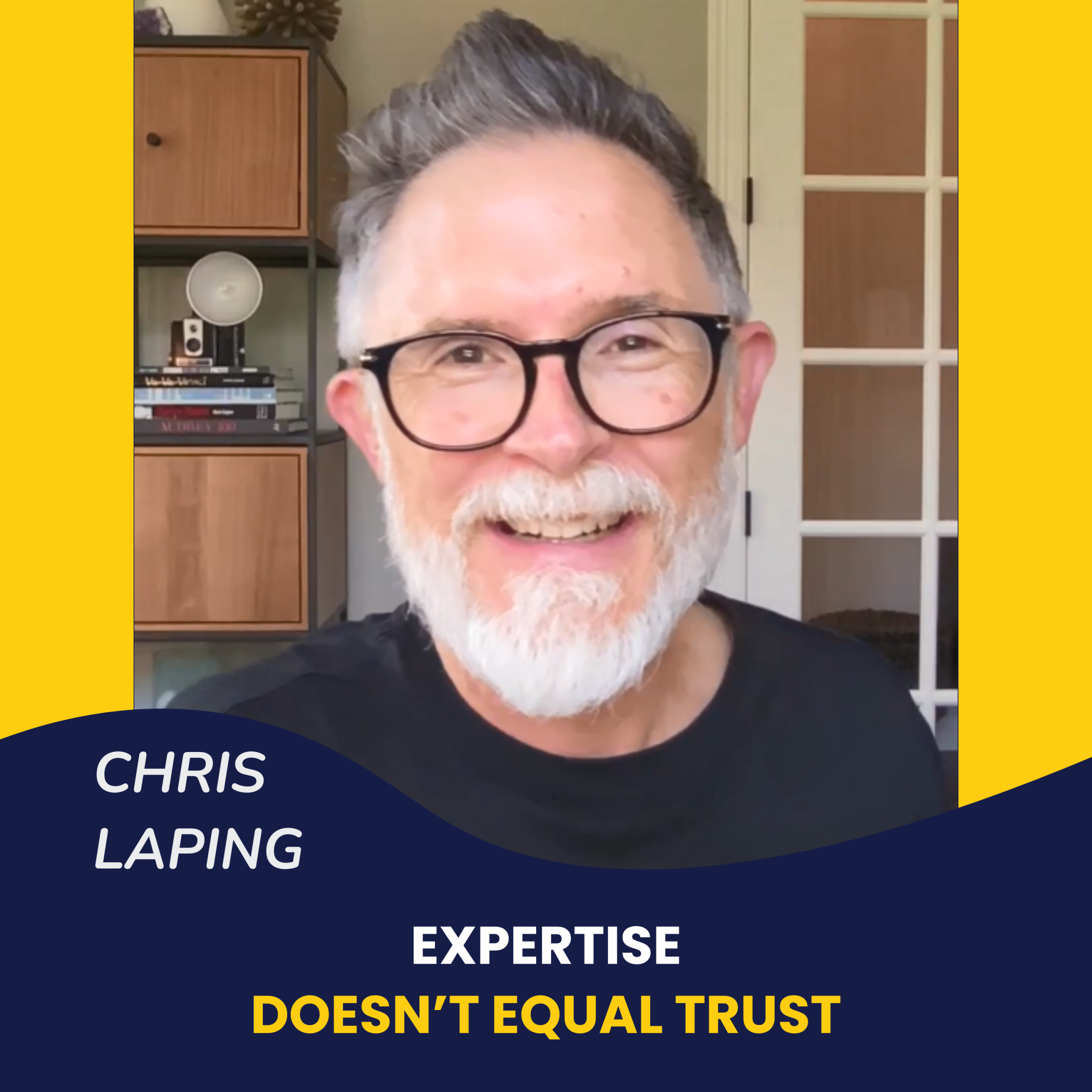
[00:01:38] Speaker C: So what does it really mean to be unignorable? And what can that mean for the confidence and success we have in our careers? I've been following Chris Lapin for over a year now, and his perspective, his honesty, and the real world experience he brings to the conversation, well, it made him pretty unignorable to me. So when I asked Chris to join us on Wavemakers and he said yes, I was so excited to have this conversation. Chris is a four time CIO keynote speaker, bestselling author of People Before Things, and his new book, the Science of Being Taken Seriously. Well, that gets into something I think so many of us can relate to. How do you know your value? How do you build the confidence to own it? And how do you create the kind of presence that gets you noticed, heard and taken seriously? Chris brings his no nonsense perspective to all of it, along with a pretty great sense of humor and a whole lot of real world insight. Trust me, you are not going to want to miss this conversation. Thank you for tuning in for another episode of Wave Makers. We are so excited to have our guest, Chris Lapping join us and we have a lot to talk about.
So I thought Chris, Carla, if it's okay, we just kind of jump right in and get started. I'm just going to throw this out.
[00:02:55] Speaker A: Let's go.
[00:02:55] Speaker B: Let's do it.
[00:02:56] Speaker A: Okay.
[00:02:56] Speaker C: And as I mentioned, Chris, I know you. You were at the C level for a long time. You even wrote that you had a great job, felt safe, and then you decided it's. It's time to leave.
[00:03:08] Speaker B: Yeah.
[00:03:08] Speaker C: Just curious what even led to that decision.
[00:03:11] Speaker B: I just felt like I could do more, to be honest with you. I was in a chief Transformation officer role at Red Robin.
We had taken an $8 stock to $89, so we were really succeeding. And I felt like the storyline around our transformation and the things we were doing was something that could help other people. And I wanted to tell that story now. I had an awesome boss. I worked for a brand that I, to this day, was one of my favorite places to work. So it wasn't an easy decision, but I wanted to do it. I felt like so many companies were struggling with change and transformation, and I felt like the people that were writing about transformation and change were largely people that had not done that work. It was written by people who had studied the work. And so I felt like that was an interesting angle, was to come at it as a practitioner. The other thing is that because Red Robin was a public company, it was really easy for the reader to be able to validate everything that I was saying in the book. It was all in the public domain, so it was really easy to access. And Red Robin was in the business of burgers and shakes, and, like, so that's pretty easy business for people to understand. And so I just knew that I wanted to do this. And I sat down with my great boss and said, you know, I think the time has come for me to hit the exit ramp. And he said, all right, well, you know, tell me what. What you're going to do. And I said, well, I think I want to write a book, and I want to. I want to share our story about transformation and change. And he just was like, that sounds about right. Like, that sounds like right in the wheelhouse for you. So he's super supportive. And. And I made the jump, and. And I never looked back.
[00:05:05] Speaker A: Wow. Did you. I mean, Chris, did you kind of dip your toe in? I mean, were you doing some stuff before you just. Or did you just jump and go all in?
[00:05:14] Speaker B: I mean, that's a great question. I used to write a playbook for my team every year.
It was like a 40 pager about what was important for us. To accomplish for the year. And a few of my team members would get these playbooks and would ask me, hey, have you ever considered writing a book? And I said, yeah, it's a snowball chance in hell that that will ever happen. But what happened to me was in 2014, I won this award called the Outlier Award.
Um, it was like this sort of black tie affair. Really wasn't black tie, but think like sort of Grammys, Academy Awards, and they have all these chief information officers in the room. And I won this award. And the. The tradition around it was that whoever won the award would keynote at the next conference.
And so it was sort of agreed upon that, okay, well, I'm going to be back next year, and I'm going to get up on stage and do this thing. And so I got up on stage, I did a talk. I was still, you know, at Red Robin, and the CEO of that organization, he, like, greeted me the second I got off the stage, and he just gave me this, like, big, heavy handshake and he was like, we can totally monetize what you just did.
So my first thought was, like, what's this we. What's this we stuff?
Second of all, what do you mean I can monetize it? And he said, chris, I. I think you could quit your day job and you could do that for a living. And so, you know, I'd gotten this feedback from my team about my writing. I had gotten this feedback about this talk. I really have been doing speaking engagements since 2004, so I wasn't a stranger to the stage. Plus, I was a rock musician in high school and college.
So, you know, I always say I was, like, born out of my mama's womb to be on a stage.
And so all of the things were starting to come together. And Christine, who's my partner in my business and partner in life, she planned a staycation for us in Boulder, and she said, listen, you keep talking about this, and we're going to resolve this this weekend, and you are either going to quit your day job and go do this, or you are going to stop talking about it, but I can't stomach this anymore. And we were there from Friday to Sunday, and I think by Friday night, I totally fully decided. And I went in on Monday and sat down with Steve, my boss, and let him know that I had made this decision. And so the rest was history.
[00:07:48] Speaker A: I love that. I mean, and this is. There's so many people right now going through this. I mean, I say within our industry, but honestly, everywhere with all the change going on. And I know, I mean, there's some things I want to talk about with your book, People before things. But can we just for on this, do you think that you would have made that move if you hadn't had Christine's support or your, the CEO, you know, support, or would you have done that?
[00:08:14] Speaker B: I needed, I needed Christine's support. I needed Chris. I didn't need Steve's support. Like, Steve's job wasn't to look after my career. His job was to grow the brand. And I was a significant contributor. And so if he had really pushed back on the notion of me leaving and put up a fight for me to stay, that would have been an interesting conversation, but would probably have not changed my mind. But with Christine, that alignment was essential.
She and I originally met each other in our career working in the same place together.
And so we've always had this context around work. And, you know, I'm just really lucky that my wife has my best interests in mind and she knew that it was in me to do this and she was not going to let me talk myself out of it. So that that made it happen. But I think for anybody who makes that leap, it's not an easy leap. And like, you know, you have the, I'm sure you all understand, like, you, you have the weeks where your business is doing great and everything makes sense, and you're like, I'm in full control and I have this personal and professional freedom. And then there's other weeks where I'm like, I would just really be happy being a Costco greeter where I have like a solid paycheck coming in the door.
You know, I have the, the benefits or whatever I could get in that job. So it's really easy, I think, to get weak on it all. But if you have a significant other or even the people around you who love you and have your best interests in mind, you know, my parents were involved in my life. My father and I do a, a weekly conversation with each other.
5:30 my time, every Friday morning. And I always say, like, at 54 years old, I'm really lucky that my father still wants to parent me.
And so he's super engaged and, and my three kids. And so when it comes to writing my books or, you know, doing something crazy like this, as long as I have their unconditional love and support, that I can totally fail and it's okay. They're going to not think less of me. Then I just, I just keep going. But I could not do Any of that. Simply as an individual. I do not have the constitution to do that in the face of everybody around me telling me it's stupid.
[00:10:37] Speaker A: Wow. I mean, that's. That support system.
[00:10:40] Speaker C: I was, I was just going to ask this. Obviously, you know all about transformation. If someone maybe is going through that, well, maybe they're just, what, you know, what's next? If not this, then what? Yeah, you know, what can I do? Either they're burned out or they're bored, but they're not necessarily ready to give up their workday career. Maybe they don't want to write that book.
Or, you know, what can someone do that's maybe going through.
I know I meant to do something else or how can I just get to that next level? So I continue to grow.
[00:11:10] Speaker B: I think the real answer is to not ignore it, but to not do something financially reckless like just quitting the day job. So the recommendation I always make to people is build it or start to design it or do something that's creating momentum for it. And I think it's okay to do that as a side hustle. I do not think it's okay at the point you start accepting money from clients for that work. It's not fair to the employer, it's not fair to yourself. It's not fair to your clients. And the other thing is that when you start selling the thing, the point I always make is if you have one, one foot in one camp, which is your day job, and you're doing all of this workday work, and then you have another foot in another camp, which is this, like, dream, you have to do something different. None of us are good enough to compete with other people who have two feet in the camp. We're not going to do well at work when the peer, our peers around us have two feet in the camp and are all in, and we're not going to do well for growing our business if we're only one foot in. We're just not that talented. No one is that talented to be able to do those things successfully. So I always just encourage people to build it, to design it, to talk to people around you about those ideas, to put those ideas out there in the universe in simple ways like LinkedIn posts and just see how people are reacting to it, but do something with the energy.
For me, writing and writing my first book, I was doing some writing on the side before I jumped and did the thing. And it was allowing me to find my voice.
It was allowing me to understand how the audience was reacting to the Things I was saying.
Introduction to the Book was one of my very first blogs that I put out there. I was using Medium at the time and the blog got a lot of energy. And so as I jumped into writing the book, I was like, this should be the introduction to the book. And so it was those little, those little experiments, right, that give us the feedback.
[00:13:21] Speaker A: That's perfect. I mean, and that, that way you're not blowing up, you know, your life, what you already, you know, what you've already got there.
Honestly. I mean, yeah, some people do, you know, paid gigs on the side if you know, and let their company know. And some companies are fine with it. We've always said the same thing is just be transparent. But the way that you describe that two feet in one camp is better than one in each. That's just, that just makes sense.
[00:13:46] Speaker B: Well, and it was true of my speaking business when I started launching speaking. And you know, I got really lucky in the beginning because I had a pretty strong network from my days of, of being a C level. So people that I knew who are willing to pay me to go do my talks, I was always embedded in these two to three day conferences where somebody else was like keynote day one and I might be keynote. And so I'd go in early and I'd watch other people on stage. And I remember one, at one conference I went to was early in my journey. I was day two keynote. And day one keynote was Greg McCune who wrote the book Essentialism. And he got up and did his thing and I just thought, I, how do I get out of this on day two? Because like, I don't know how to follow that up. But the lesson for me was in that moment, hey, I'm not at that level right now, but I am committing myself to get to that level and I want to do everything I can to be stronger on stage. And I am going to study this like a craft. And you know, 11 years into it now I'm day one keynote for any conference I'm in. But I've had two feet in the camp and I have like really poured into what do great speakers do. And so I feel sorry for someone who's got one foot in the camp and is going to try to like sort of insert themselves in, in that process. I mean, it's hard.
The people that are doing this for a living are studying it every day and it's not a side project for them, it's what they do for a living. And you know, it's hard to compete with Those folks.
[00:15:24] Speaker A: That's true. That's true.
You know, right now we're focused, obviously, because you went and you started your own business. But let's just even say anyone wanting to make a move, whether it's to a new company or a new position or a new industry or starting their own business, you know, it's so easy to get in that stability mode, and if it's not broke, don't fix it kind of thing, but it is broken. You were already doing stuff and may not had realized it and people had told you about it or pointed it out to you, and you kind of had that, aha. You know, what would be advice for people that are maybe in this stable mode and they don't, you know, I don't know if that's the right way to ask it. They don't know what they don't know or.
[00:16:03] Speaker C: Right. Can't even, you know, maybe not recognize those talents and gifts that they have that maybe other people keep telling them, you know, what can they do to embrace that and put themselves out there?
[00:16:13] Speaker B: Yeah, there's. There's two things I'll share, and they're. They. They're gonna. They're, like, completely disjointed, which is kind of, I guess, the way I roll. The first is Christine asked me a really interesting question that flipped the script on the consideration for leaving.
Instead of asking me, what is the risk of leaving, she asked me, what is the risk of staying? And this allowed me to articulate some things that were floating around in my head that I had not fully processed, of which, you know, when I was a chief transformation officer at Red Robin, I was also the chief information officer. And at that time, this is 2015, there's just a lot of security breaches going on. And today, you know, most of us get a letter when that happens, and we sort of shrug our shoulders and move on.
In 2015, that crushed your career, and you were done. And so part of the risk of staying was just this onslaught of. Of bad actors doing bad things and what the impact would be on my career. So I would ask people who are listening to this that might be in this situation to really consider what are the risks of staying where they are. So that's point one. Now, the disjointed point related to this is when I do life coaching with people, I do this exercise called why Do They Love Me? And what I ask someone to do is identify why the people that love them, who surround them, love them most. And they write down these things, and I Think especially for women, right? A lot of women will carry the burden of the household. As an example, they'll say, you know, I cook dinner, I go grocery shopping, I help the kids with homework, I drive the kids to school. The second part of the activity is I ask the client to, okay, go ask the people around you why they love you. And of course, when they come back with their list, you. You can predict the list does not line up. In fact, what the kids say is, I love mommy because she sits on the floor and plays Legos with me. I love mommy because she reads books to me. I love mommy because she takes me to the park. I love mommy because she buys me treats. Every once in a while when we're out and about, it's like these really simple things that cause the people around us to love us. But what we do is we turn ourselves inside out to give people around us love, to earn their love. And we're doing all this work that we're not getting credit for that. What ultimately they want is something different. So this activity works professionally. Why do they love you? If the people around you at work were asked why they love you, why they love working with you, what are they going to say? And for anyone on this, listening to this, who's like, well, that would be really awkward to go ask, just say, my coach asked me to ask you, and just pretend for a minute that I'm your coach. And so you go, and you, you ask your boss or you ask your peers. This is the thing that people would print on a T shirt for you, the one liner that describes what you're about. And it's really amazing what people that we work with, what they really appreciate about us, and yet we're trying to earn their love and affection in ways that they don't even notice or care about. And so I had a boss once, did not like this boss, but this is the way it always works. You know, your least favorite bosses you end up learning the most from.
The phrase he used to always use is, what is your unique unduplicated role in the organization? And that unique unduplicated role is the thing on the T shirt. It's the reason why people around you love working with you. Honest to goodness, you can build a strong business around some of the simplest statements of things that you do so well that you do not give yourself credit for. But everyone around you loves when you do those things. And therefore, you know, we. We don't have to work as hard to. To earn this love around us that
[00:20:24] Speaker A: is so powerful, Chris. I feel like I should, I don't know, send a check. I mean, just even that, like the what, what you just said on that, I'm just like. I mean, I'm just sitting here nodding, nodding my head. Wow. You talk about visibility versus what's the trusted authority. So you get the ideas from the team. You have someone, or maybe they're people that are just visible and they're the ones that talk all the time. Then you have the ones that you knew, like, okay, this is trusted authority. What's the difference?
[00:20:53] Speaker B: Yeah, I mean, I, I think about the, the whole movement around personal branding and, you know, with us being business owners, it like brand matters to us. But I think the personal branding industry is, is selling us a lie, which is that if we just had more visibility, we would get everything we wanted in our career, in our businesses. And something that I'm really focused on in my new book, you know, and really bringing the reader along in the journey, is that visibility does not equate to goodness in our careers. That it's about trusted influence. And this is different than, like positional authority, where you're the boss. This is different than visibility and personal brand, where it's like, look at me, look at me, look at me. Trusted influence is that when people around us, they can answer two questions. Does Chris know what he's talking about? Do I trust Chris? And that unconscious audit happens every day when we're working with people and interfacing with them. Now what we do is we give too much focus to the first question. Does Chris know what he's talking about? So when we want to earn love and respect from the people that we work with, we are focused on credentials and experience and education.
And if I just get 10 more certifications and I walk in the room, people will listen to me. But what the research shows is that it's the second question that actually gets in our way. Do I trust Chris? And that there are behavioral things we do that open doors for us with other people in terms of building trust. There was a really interesting body of research called the Neuroscience of Trust. And with the research, and I don't know how they do these things, but they were able to measure oxytocin release in a professional setting. And oxytocin, of course, is the hormone that creates belonging and it's connection and gives us the warm fuzzies around people that we're, that we're with. And the research just showed over and over and over again that it wasn't that smart. Side of the equation that was drawing oxytocin release that it was simple behaviors and the way we show up with other people and the way people experience us that cause us to have that trusted influence. But when I think about somebody with trusted influence, they are the person who sits in a room generally are quiet for a lot of a meeting. They're taking in a lot of information. I really think about my introvert friends who are really good at observing what's really happening in the room. And then they, they drop a bomb on us in the meeting, right? They like drop two or three lines and we are all leaning in and want to know more. And it's not just about that silence or introversion that causes that, but it's the person who shows up and they're like incredibly easy to work with and they are really adaptable and they're good at unlearning, you know, bad beliefs that they've been carrying around. And that's what the focus of the new book the Science of Being Taken Seriously is. It's me asking the question, okay, if it's not credentials and degrees and certifications, then what is it that builds trust? And the conclusion from all that work is you shouldn't have to be loud and play politics and be self promoting for your ideas to be heard. And the, and you, and you don't have to do those things at all. So trusted influence to me is the thing that we all should be working toward. And that's, that's that truth is there. For leaders that do not lean on positional authority to get your work done. It's not going to move rooms, it's not going to create sustainability. And for contributor level people, it's the same thing. You do not have to have title and you do not have to lead people to still walk in a room and for your ideas to absolutely change the organization that you're a part.
[00:24:57] Speaker C: And you mentioned, you mentioned that that book Unignorable, that book is not out yet, but I know that people can get on a waitlist for that and we will have that link. Everything will be there so that they can get on that. I cannot wait. I was going to ask you, Chris, in regards to that book, I mean the first book that came out was People before Things, which was a heavy leadership focus and change management and kind of was there something. And now Unignorable is kind of being that voice, right? Regardless of title and level, that there are behaviors that people that are unignorable have, was there some kind of shift Some kind of conversation that. This. That you decided. All right, I talked about this.
[00:25:39] Speaker B: Yeah.
[00:25:39] Speaker C: Now I'm going to completely turn around. My second book is going to be more at this level.
[00:25:43] Speaker B: Yeah, I mean, it's a good question. With the first book, I got to work with 300,000 change makers and I got this really interesting, I'll call it Passenger Seat View as to what was working with changemakers and what wasn't. And what was interesting to me was that I had clients who they were doing everything that the book really pushes a leader to do in people before things related to change. But something was still missing. And this is where it started to become very evident to me that a lot of these leaders were missing the credibility when they walked in rooms to build buy in, that even if they were doing things right, they still were not earning the room's affection on their ideas. So initially I was trying to solve that. What is causing this credibility gap, this trust gap? And then I realized in that work, this is actually not a leadership problem. This is just a human challenge where we all have ideas to make change happen. But we sometimes have a hard time getting people to hear those ideas. Whether you're on an HOA board or you're trying to convince your significant other that you should be moving to a different home or a different community, whether you're a boss at work and trying to get your team on board, or you're a contributor level person who has a great idea but you can't get your boss's attention. And so I started to pour in, what is high trust influence and how do we earn this? And of course, I went down the personal branding rabbit hole initially. Is this about brand? Is this, you know, something that people can build up with just fancier packaging of themselves? And it was in the process of really researching the book that I just realized, like, no, this, this is a behavioral thing. This is human behavior, and it's how we show up at work and it's how people experience us. And I wanted to know, like, with precision, what are the behaviors that when we exhibit these at work, it changes how people experience us and then builds that trust. So that was a long answer. Everything's a long answer with me all the time.
[00:28:10] Speaker A: No, it's all so good. It's all so good. You know, you were talking about this and you even said you were talking certifications or credentials or people were like, I'm, I know my technology.
You know, it always was like, I know my technology in and out, and yet they still can't influence anything. Why is that? I mean, it's like it's more than just the work itself.
[00:28:32] Speaker B: Yeah, it is more than the work. But the beauty I think for people listening right now is it's simple behaviors that do not require a personality trait to be able to execute. In the book, I go through five behaviors. The first behaviors be easy to work with. This is all about our energy, our words and our systems. Our energy is our presence and how people experience just how we deal with life. Our words are do we communicate clearly? Do we attach a call to action when we communicate to people so they know what we're asking them to do? And your systems is sometimes we ask people to jump through hoops to get our help and those hoops piss them off. And there might be some like substantially good reason that we justified or rationalize why they have to fill out the 20 page form to get help on a project. But these are all friction points that our emotional presence, our words, our energy or our our systems are all friction points. So the first one is be easy to work with. Second one is be good at unlearning. A lot of us are carrying limited beliefs and mantras, unconscious biases around with us that we never test is this in fact true? And we espouse it as if it is true. And the way that gets read in a room, it's like when someone walks in a room with a 1980s haircut. Like, everyone knows something's wrong, but they don't like say something about it. People will not give you feedback. At work when you use a mantra that's outdated or you have a belief that's outdated, instead they just write you off. So in the book, I suggest that any mantra like process or framework you use, like if you're an agile disciple and you learned Agile more than 24 months ago, you learned a mantra more than 24 months ago, you have some kind of belief that you learned 24 months ago or later, like stop believing it, go question it and find facts and data that says that it's true and when it's not, to revise and be able to unlearn. The third behavior I talk about in the book is have an original take on a problem. And the concept's really simple. That is, when we walk into meetings, we try to earn people's trust with our solutions and answers. People do not care about our solutions and answers until they know that we understand the problem they're trying to solve. So to build a bridge with people in a room isn't to Come in with a solution first. It's to come in and talk about their problems in a way that they go, my God, Chris, like, totally gets it. He knows what's happening. And that's what's really interesting. Even for entrepreneurs. People do not buy your products and solutions. They buy your ability to play their problems back in a way that says you get it. The fourth behavior is to sell without slides. It's the PowerPoint paradox. The very tool we use to walk into a meeting and earn credibility, to show that we're organized, that we put the thought ahead in place before coming into the meeting, is the very reason why people are disconnected from us. That a PowerPoint presentation is a wall. And what it says is that your ideas have been decided and you're not interested in people modifying it. And so in the book, I encourage the reader, try going into a meeting and Instead of a PowerPoint presentation, do a day in the life of story. So when we were talking about the. We waste time tracking time earlier in the conversation. Go in and tell the story about the contract electrician who absolutely loves doing what he does for a living, but cannot stand desk work and is causing him to want to walk away from this field and profession. That will move the room. Not like some PowerPoint deck. And then the fifth behavior that I talk about in the book is be a serial wanderer. Whatever you do from a presentation perspective, an idea you share, always finish it with, how can I make this stronger? What am I missing? What other ideas have we not explored? Being a serial wanderer, not wanderer. A wanderer is to ask people for their ideas and then to attend to their answers and take demonstrable action on that. So those five behaviors do change the way people experience us. And it opens the door for new opportunities. It opens the door to be a sought after resource because you're somebody that's like moving the room when you're in the room and it gives you the personal and professional freedom going forward. That feels really great when people trust you and trust your ideas.
[00:33:22] Speaker A: Wow.
[00:33:23] Speaker B: So all of that said, I do have an assessment that I have for that and I, I think I only scored a 65 on my own assessment. So, like, we're all on this journey together.
[00:33:34] Speaker A: Yeah, that's in that assessment now.
[00:33:37] Speaker C: Well, I will definitely be on that wait list.
[00:33:39] Speaker B: Okay.
[00:33:40] Speaker C: I'm glad you shared those. It's just so powerful.
[00:33:44] Speaker A: Well, it's marketing. Right? That's marketing. You, you describe someone's problem better than they describe it themselves.
[00:33:50] Speaker B: Yes.
[00:33:51] Speaker A: And where everybody kind of Looks the same. Everybody has a certification. Everybody, you know, list job descriptions on their resume or they're using AI to come up with their, their resume and it perfectly matches the, the job order. Instead of telling their story, which is, and telling it in a way that I understand the problem you're going through. Here's what I experienced and, and actually experienced, not that I went and pulled out some stuff from a training manual and just repeated it. Here's the solution, which Chris, you keep saying that over and over again. Don't lead with the solution.
[00:34:26] Speaker B: Yeah, that's right. In my LinkedIn profile, my headline is, you shouldn't have to shout play politics or self promote to be taken seriously. That's what I'm saying. I'm not like, follow my Unignorable 5 framework to make your life better. Like, nobody cares about unignorable five. I'm not, I'm not leading with four time CIO and bestselling author. Nobody cares about that. What they care about is do you have some relatability to them on a problem that they're trying to solve? So for me, on my LinkedIn profile, I just call out that the problem that I work on versus calling out the solution or the who. Like, I'm not going to lean into credentials because I think like, the humbling fact is that when I left the day job, no one like legitimately cares where I've been.
What they care about is, hey, I have a problem. And I think that Chris can help me solve that problem or not. Right. Like, hey, Chris is a loudmouth. I don't like his stuff. And then they move on, which is totally fine if that's the conclusion they reach. It's only fine now. It would have been devastating 11 years ago, but it's fine now.
[00:35:38] Speaker A: But do you know, there's someone in marketing that I've been following for a long time and he said it's okay to have someone disagree with you. It's okay to have someone unfollow you. It's okay to, you know, make someone mad. It's okay.
[00:35:52] Speaker B: Yeah.
[00:35:53] Speaker A: Because that's what makes it human. And you're not going to be for everyone.
[00:35:57] Speaker B: No.
[00:35:57] Speaker A: So you kind of mentioned that earlier, before we started the podcast, that after the first book and you had all the speaking engagements and the, the, the book sales and the followers, you kind of hesitated a little bit.
[00:36:12] Speaker B: Yeah.
[00:36:12] Speaker A: And pulled back some from your, your edginess got safe, which is what attracted these people in the first place.
[00:36:19] Speaker B: Right. Yeah. It is funny how that works.
I'M glad I caught myself in the process, but I definitely had a period of time where I did a lot of overthinking and even therapy about my overthinking. I'm in this because I'd love people to consider a different way if it's helpful to them. And of course, you want that to be broadly applicable and useful to people. But I do think in the safeness we, we me, I leave things on the table. I think we do. I do that because you don't want to leave something on the table. It's like people, when they're. I'm sure you see this when they stack their resumes and they've like, they put any technical thing they've ever even touched for just like, even 20 minutes in the, in the resume. They're doing that because they don't want to leave anything on the table. But it's by doing that that they leave a lot on the table because it creates so much noise that the audience or the reader or the employer, the hiring manager doesn't know how to sort through it, doesn't see a cohesive story, just sees, like, business bingo in every technical thing they've ever done.
[00:37:29] Speaker A: Yeah, yeah, that's true. We've seen those.
[00:37:32] Speaker C: Yeah, well, and also just being human and I mean, that's separating you from, hey, it's the AI generated resume.
[00:37:40] Speaker B: Yeah, you are you.
[00:37:41] Speaker C: Nobody else is. So just share that.
[00:37:45] Speaker B: I had a, I had a T shirt on the other day.
It. It says, be a good person. And this guy was. I was at some baseball fields and he was, he was walking by me the other way and he just like, blurts out at me, well, what if I don't want to be a good person?
And I was like, you do. You boo. Like, yeah, exactly.
[00:38:04] Speaker A: Right, exactly. I love that line.
[00:38:06] Speaker B: Just, you do it, you do it. I mean, like, yeah, but I mean, again, I think that, that, I think it. It's universally human that we want belonging and connectedness. And in that, I think sometimes we do compromise ourselves. And in particular, I've done this quite a bit where I overthink it or somebody. You know, like, I. I have posted every single day on LinkedIn since March 5, 2023.
And there are days where people will drop something into the comments, like, you know, I can't believe, blah, blah, blah, or they will make the counterpoint to my point. And you, you all remember the old, like the old Chris Farley skit where he, like, he hits himself and he's like, oh, I'm so Dumb.
And he. Do you remember that skit?
[00:38:57] Speaker A: Yes.
[00:38:58] Speaker B: Like, he's interviewing Paul McCartney, and he, like, asked Paul McCartney this question, and then he gets, like, he realizes it was a stupid question, and he, you know, Chris Farley was such a physical comedian.
[00:39:10] Speaker A: Yeah.
[00:39:10] Speaker B: That's how I feel sometimes when I put the post out. Like, someone will say, yeah, but what about such and such? And I'll be like, oh, geez, I'm so dumb. Like, why didn't I see that? Sometimes I wonder how I made it 11 years in this. Because I.
[00:39:25] Speaker A: Look, I. I mean, I haven't posted anywhere near like you have, but, yeah, there have been times that I overthink it and don't put it out there at 50%. And, you know, just because of fear for that. And it's like, what difference does it make? What difference does it make if someone says something or it's not like. Or someone comes back with something you haven't thought about? You know, that's true.
[00:39:46] Speaker C: So, I mean, there's people that. I mean, you're just. At least you're putting it out there, right?
[00:39:50] Speaker A: Whether.
[00:39:51] Speaker C: I mean, you know, there's people, unfortunately, there's people that have a lot of things to share and say and teach, and they just kind of are waiting for the right time or they don't have that confidence.
[00:40:00] Speaker A: All right, well, Nikki, do you have anything else before we take Chris through the barrel rush?
[00:40:06] Speaker C: The barrel rush. And Chris is like, what the hell am I doing?
[00:40:09] Speaker A: I love it. What the heck is this?
[00:40:10] Speaker C: Think of Florida. Right? Right. You grew up in Florida. For a little bit of time, it's just getting in, get that wave, you know, getting in real quickly and then getting out. So it's kind of like the lightning round. There could be no wrong answers, whatever comes to your mind first.
[00:40:24] Speaker B: But anyone has ever told me to keep it brief, there's no wrong answer that was, like, not accurate at all.
[00:40:31] Speaker C: Well, we won't judge.
[00:40:32] Speaker A: All right, I'll start it out.
[00:40:34] Speaker C: Are you starting it?
[00:40:35] Speaker A: So what's the first thing that someone needs to identify before they can decide what they move to next?
[00:40:41] Speaker B: There's no barrel rush here. That's a deep question.
I think they need to decide that. And I, like, when I say decide, like, they have to really accept that they want more for themselves than they have now. So basically, the question I would ask myself would be like, what do I want most in my life and work that I don't have right now? And when they answer that, if there's no way for them to get that right now. Then they've decided. And what? And don't punt. Don't punt. Like I'll decide another day. Because that's a decision.
A no decision is a decision for the status quo. Okay, that was not barrel rush. That was like too many sentences.
[00:41:19] Speaker C: That's okay.
[00:41:19] Speaker A: No, that was good. That was good. That was good. We'll take it. Maybe barrel roast just means our question. That's good.
[00:41:25] Speaker C: Sue, you mentioned that there's five behaviors in the book. Unignorable or make someone unignorable. What do you think is the hardest for people out of those five?
[00:41:36] Speaker B: I would say this is because of the early read I have getting up in front of audiences and talking about this for the last year already. It's the sell without slides seems like it's the toughest one for people to swallow. They just believe that they are in a work environment that requires the pre read, requires the slides in advance. And I will just reiterate that that is one of the most harmful things we can do to ourselves when we're trying to build, buy in for our ideas. I think the one that people act like is easy is to be easy to work with. And I actually think if anyone reads that chapter, what they will likely conclude is this is going to be a 30 or 40 year journey to figure this out.
[00:42:18] Speaker A: Wow.
[00:42:22] Speaker B: Without slides.
[00:42:24] Speaker A: I want to add on to this and I can't because we're in the barrel rush. I want to add on questions, but. All right, go ahead, Nikki. We're in the wave.
[00:42:31] Speaker C: I mean, you want to add or not? You want to.
[00:42:35] Speaker A: Why is it a 30 to 40 year? Is it just ever evolving or.
[00:42:39] Speaker B: Yeah, I mean like the. Again, if you go back to your energy, your words and your systems, our energy, our emotional presence is a work in progress always. As humans, we just. It's not a binary, like, hey, am I easy to work with or not? It is. How can. What can I do today to be easier to work with? But you know, our emotional presence is so uncontrollable for, for many of us. I. I was running along, having a great day, minding my own business today and, you know, got a letter from the HOA that like took me right back to third grade. Emotional presence, like I was just not functioning in an adult.
[00:43:22] Speaker A: Never happened at all.
[00:43:24] Speaker B: Yeah,
[00:43:27] Speaker A: never ever happened to me.
[00:43:30] Speaker C: All right, I will conclude this barrel rush with my favorite question. And this is going to be interesting because you're in the band. This is going to be cool. So Chris, what is your favorite go to song for a little extra motivation, a little pump up or when you're just kind of having a crappy day. What's your what's that song that you hit?
[00:43:47] Speaker B: I love the song. Unstoppable by Sia is it is the go to for me. It's my walk up music for my speaking engagements.
[00:43:56] Speaker A: Nice.
[00:43:57] Speaker B: When I leading up to a big event, I will generally run that song over and over and over again.
I want to believe everything she's saying in that song. And you know, sometimes I believe it and sometimes I don't but at least gets the fire in the belly going.
[00:44:14] Speaker A: Nice.
I love it.
All right, you made it Chris. You made it through the barrel rush. So I just I am so glad that you joined us today. When Nikki brought your profile and your writing to my attention, I was like that whole self doubt. You do think we Chris would even take the time to talk with us in our audience And I'm so glad that you did. I've learned so much today and can't wait to go back through this and you know, your realness, what you have in the books, you practice and have practiced and and that's just so refreshing to see and we just thank you so much for being part of this.
[00:44:54] Speaker B: Well, thank you to the two of you for having me and thank you to your audience who hung out and hung in there the whole time with us.
[00:45:04] Speaker C: Thank you Chris. This has been fantastic. I'm super excited about about this one.
[00:45:10] Speaker A: Chris gave us a lot to think about in this one, especially that question around the risk of staying. We'll put links to Chris People before things and his upcoming book unignorable in the episode notes. And speaking of unignorable, this conversation has you thinking about how you're positioned in the way workday ecosystem when you contribute your compensation anonymously. At wdbeacon.com, we'll send you 10 strategies you can implement today to stand out in our market.